Customer Retention Strategies for Service Businesses: How to Keep Your Best Customers
New customer acquisition gets most of the attention. Retention generates most of the profit.
Research from Bain & Company shows that increasing customer retention by 5% can increase profits by 25% to 95%. For service businesses — where referrals and repeat jobs are the lifeblood of growth — this isn't abstract. A customer who uses your landscaping company once and never comes back is worth far less than one who schedules three times a year and refers two neighbors.
Your CRM is the most practical tool you have for building retention systems that scale beyond what any single person can track manually. Last updated April 2026.
Why Service Business Customers Leave
You can't build a retention strategy without understanding the actual reasons customers don't come back. For service businesses, the most common causes are:
You didn't follow up. The job was fine, but nobody reached out afterward. The customer eventually needed the service again, called the first company that came to mind (or the first result on Google), and that wasn't you. The same follow-up gap that kills lead management kills retention — just at a different stage.
The experience was inconsistent. Great service from one tech, mediocre service from another on the next visit. The customer liked the company but didn't trust they'd get quality consistently.
A competitor was more proactive. Your competitor sent a seasonal reminder. You didn't. Not because your work was worse, but because their retention system was better.
An issue went unresolved. Something wasn't right after the job. The customer didn't complain loudly, just didn't come back. You never knew there was a problem.
Life changed. Sometimes it's not you — the customer moved, changed their budget, or no longer needs the service. This churn is unavoidable. Everything else is not.
The Retention Framework
A practical CRM-driven retention strategy covers four phases: onboarding, ongoing engagement, proactive health monitoring, and renewal.
Phase 1: Onboarding — Set the Foundation
Retention starts on day one. Customers who have a smooth first experience stay longer, complain less, and refer more.
For service businesses, onboarding is often a single job — which means you have one shot to make the right impression before the next competitor email lands in their inbox.
After every first job, do three things:
-
Send a completion summary — what was done, any notes or observations, what to expect next. This takes 2 minutes and dramatically increases perceived professionalism.
-
Provide a clear next step — when the next service is due, what to watch for, how to reach you with questions.
-
Make it easy to give feedback — not a formal survey, just "did everything look good?" A short reply window catches problems immediately rather than losing the customer silently.
Configure these three steps as a post-job completion workflow in ProFlow360. Once built, they run automatically for every new customer without anyone having to remember.
Phase 2: Ongoing Engagement
The goal is staying top-of-mind without being annoying. For most service businesses, this means:
Seasonal and recurring service reminders. If you do HVAC, gutter cleaning, lawn care, pest control, or any other seasonal service, automated reminders before service windows are the single highest-ROI retention activity. ProFlow360's scheduling tools make setting these up straightforward. Customers who receive a proactive scheduling prompt convert at much higher rates than customers who have to remember on their own.
Occasional value-add communication. A brief note about something relevant to your customers — maintenance tips, seasonal prep, a product or technique that's improved your service — keeps the relationship warm without pressure. This should not be a monthly newsletter. Once or twice a year is plenty.
Anniversary recognition. A quick "we've been handling your [service] for a year now" note stands out because almost nobody does it. It acknowledges the relationship and prompts customers to think about upcoming needs.
Phase 3: Customer Health Monitoring
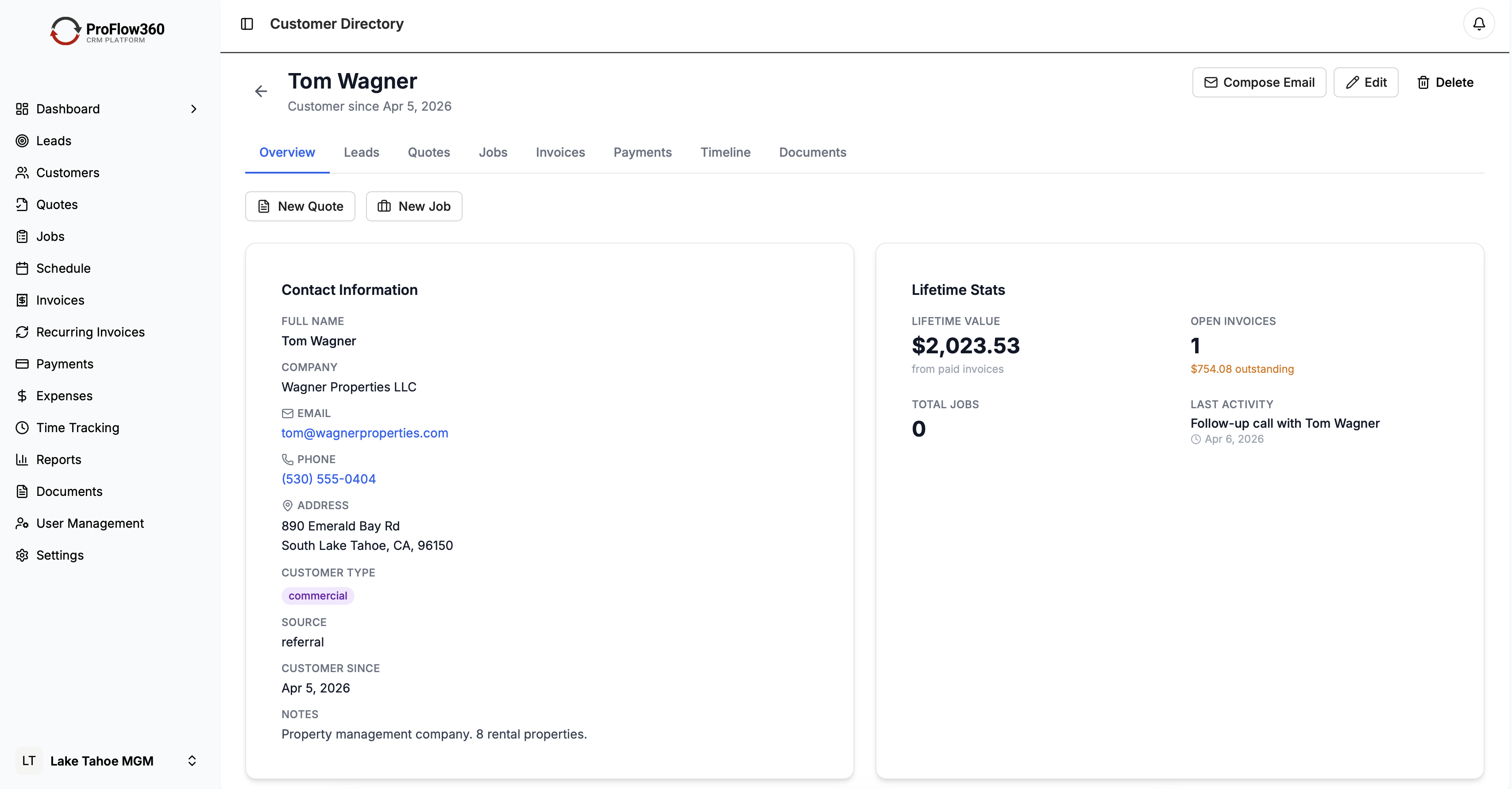
Not every at-risk customer announces they're leaving. Most just stop calling. CRM lets you see the warning signs before it's too late.
Signals that a customer is at risk:
- No service in 18+ months when their typical frequency was 6–12 months
- A recent complaint or negative review
- An open issue that hasn't been resolved
- A payment dispute or billing problem
- A pattern of rescheduling or cancellations
Configure alerts in ProFlow360 for customers who meet these criteria. When a customer hasn't booked in longer than their typical service interval, flag them for a proactive outreach call — not an automated email, but a real phone call from someone who knows their account.
Create a simple health score based on these factors:
- Time since last service (penalize if longer than typical interval)
- Issue or complaint history (penalize if unresolved)
- Payment history (penalize if late pattern)
- Communication responsiveness (reward if responsive)
Customers in the red zone get a phone call. Customers in the yellow zone get a personal outreach email. Customers in the green zone get the standard nurture sequence.
Phase 4: Renewal and Long-Term Loyalty
For contract customers or recurring service agreements, renewal management is a profit center, not an administrative task.
60–90 days before contract renewal:
- Review the account history and compile results — jobs completed, issues resolved, value delivered.
- Schedule a business review call for larger accounts.
- Prepare a renewal proposal that acknowledges the relationship and presents the next year's terms.
30 days before renewal:
- Follow up on the proposal.
- Address any concerns.
- Make it easy to renew — a link to sign, not a series of calls.
7 days before renewal (if not yet committed):
- Escalate. A personal call from the owner or senior manager goes a long way. Customers who feel valued close renewal conversations.
The businesses that lose renewals usually lose them through neglect, not competition.
Segment Your Retention Effort
Not every customer deserves the same retention investment. Segment by value:
High-value customers (top 20% by revenue): Deserves the full white-glove treatment — proactive outreach, assigned point of contact, quarterly check-ins, first access to scheduling. Losing one of these customers has real financial impact.
Mid-tier customers: Systematic engagement through automated sequences, standard service reminders, occasional personal check-ins. Good service and reliable follow-up is usually enough.
Low-value or occasional customers: Digital-first engagement — automated reminders and emails. Human touch only when there's a specific issue or opportunity.
Configure this segmentation in ProFlow360 using customer tags or custom fields, then build workflows that apply different engagement sequences based on tier.
Measuring Retention
Track these metrics quarterly:
Customer retention rate: What percentage of customers from 12 months ago are still active? Calculate separately by customer segment.
Repeat job rate: Of all customers, what percentage booked a second job within 12 months? This is the most direct measure of retention effort.
Average customer lifetime: How long do customers stay on average? Improving this even slightly has compounding revenue impact.
Referral rate: What percentage of new customers came from existing customer referrals? High retention drives high referral rates.
Net Revenue Retention: Total revenue from existing customers this period versus the same period last year, including expansion. Target above 100% — which means customers are buying more over time, not less.
The ROI of Retention
Here's a simple model for a residential service business:
- Average job value: $350
- Customers served last year: 200
- Average jobs per customer per year: 1.8
- Current 1-year retention rate: 55%
Improving retention from 55% to 70% — keeping 30 more customers year over year — at 1.8 jobs per customer adds 54 incremental jobs annually. At $350 each, that's $18,900 in additional revenue before any new customer acquisition. And it cost the price of a CRM subscription plus a few hours of workflow configuration.
Conclusion
Retention is not complicated. It requires consistency, and consistency requires systems. A CRM with the right automation handles the routine touchpoints automatically — follow-ups, reminders, check-ins — so no customer falls through the cracks, and your team's personal attention goes to the relationships that need it most.
ProFlow360 is built for exactly this — explore the full feature set and pricing. The retention workflows described in this guide can all be configured and running within a day.
Tags
Mark Shvaya
Founder, ProFlow360
Sacramento-based broker and property manager. Built ProFlow360 to solve the operational chaos he lived through managing 50+ doors and a field service team.